Large enterprise
IT and business leaders who need AI adoption to stick — with the people the enterprise values most leading it.

The coaching model
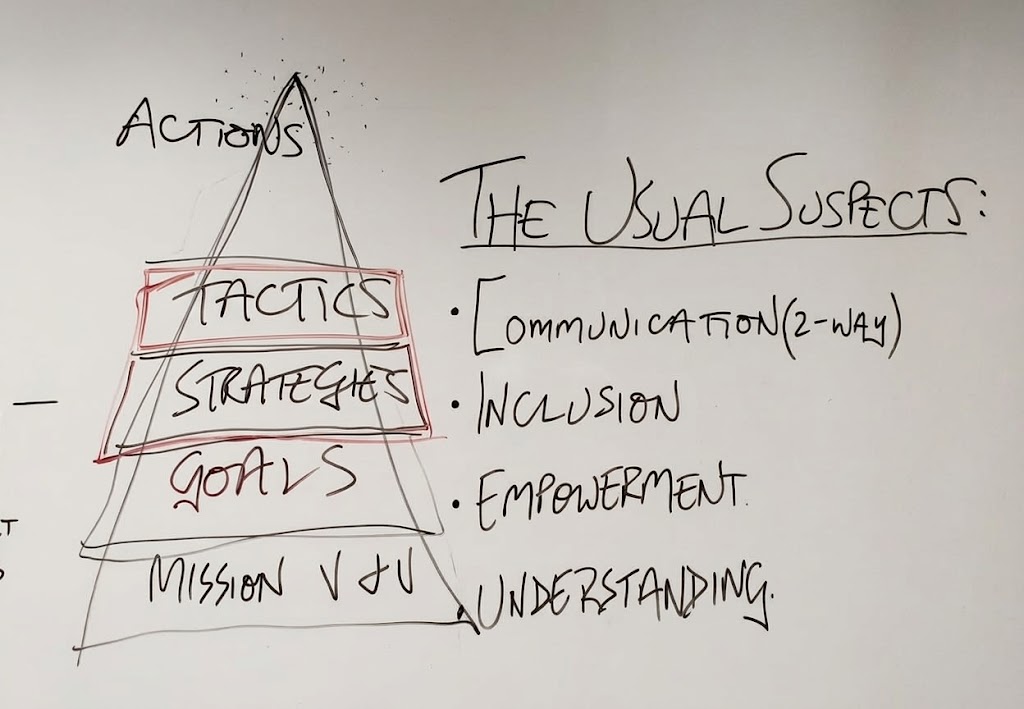
We teach a leadership doctrine of leading from the middle — where strategy meets the work, with capability growing from the people doing it. We build with your team until AI-enabled value is visible, measurable, and transferable.
IT and business leaders who need AI adoption to stick — with the people the enterprise values most leading it.
Innovative operators who want enterprise-grade AI capability without enterprise-grade overhead.
Investors who want portfolio companies energized — measurable AI value that shows up in the numbers.
Show what AI-enabled value looks like with your own data — a working prototype, live model, or measurable result, not vendor hype.
Pressure-test assumptions, data, and the business case — starting with an honest baseline of what your people actually use and can do.
Build with your people, not for them — strengthening trusted domain experts, operators, and managers so they lead adoption rather than being sidelined by it.
Strategic judgment and hands-on technical depth in the same team: small and senior by design, with the people who win the work doing it.
Each AI capability gets an accountable product owner, real users, a problem worth solving, a roadmap, and success measures tied to the ROI case.
Living data products, ontologies, and models that can be queried, stress-tested, and evolved — with outcomes testing assumptions against reality.
Data establishes what is true. Ontology defines what it means. Models explore what may happen. Platforms put insight to work. People decide, learn, and improve.
Examine sources, lineage, quality, and the gaps between what systems report and what the business believes.
Build and govern a shared, machine-readable model with domain experts — entities, relationships, and rules so people and AI reason from the same reality.
Build and challenge predictive, generative, and agentic models; simulate scenarios and test assumptions before committing.
Define the tools, integrations, ownership, and costs in scope; connect them to production workflows and verify real use and measurable results.
Humans remain accountable for context, ethics, stakeholder consequences, and the final call; each outcome updates models and sharpens the team's judgment.
If AI is inside the work, then the work must be explainable. Every process we design is structured. Every conclusion we reach is auditable. Every model we build is revisable. Every insight we deliver is teachable — to both humans and machines.
Your team can inspect, challenge, and learn to reproduce the reasoning — tracing data, analytical steps, model inputs, and human choices. When a model cannot fully explain itself, we say so and design the decision around that limit. People learn from models; models learn from human feedback.
We teach product management as the enabling discipline around every AI program: discovery with users, prioritization by value, small releases, feedback from real use, and clear choices about what to improve, scale, or retire. Your team owns not just the system, but the practices that keep it useful.
Models widen the field of options; together, we narrow it to the choices that matter and make trade-offs visible, comparable, and concrete. We support iteration, not closure — the best available answer now, and a team equipped to find the next one. We do not replace your people or their judgment.
Every engagement names its exit at the start: the specific work your team should perform independently. Part of our fees is tied to capability milestones rather than hours or headcount. We step back when your team can run the cycle without us.
A baseline, a metric, and a value the CFO would sign — agreed before the work begins and tracked after it ships. Treating the five layers as one system converts AI capability into measurable enterprise value.
MIT's Project NANDA preliminary findings reported roughly 95% of enterprise generative AI pilots produced no measurable P&L impact — and success rose when managers and front-line teams shaped adoption.¹ BCG's research describes roughly 10% of AI leaders' effort going to algorithms, 20% to technology and data, and 70% to people and processes.² That 70% is change management: role-based training inside real work, redesigned workflows, and visible early wins.
¹ Challapally et al., "The GenAI Divide: State of AI in Business 2025," MIT Project NANDA, July 2025 (preliminary findings). ² Boston Consulting Group, "Where's the Value in AI?", October 2024, based on a survey of more than 1,000 CxOs and senior executives.
| Conventional advisory & integrators | Whip-Smart coaching |
|---|---|
| Top-down, centrally controlled AI programs | Bottom-up enablement, led from the middle |
| Rolls out tools and leaves the experts behind | Change management that builds up the people the enterprise values most |
| Training as a one-time event | Role-based training built into real work |
| Strategy separated from execution | Thinker-doer: strategy plus hands-on delivery |
| Project-managed pilots with an end date | Product-managed AI capabilities with owners, users, and roadmaps |
| Systems delivered, then operated for you | Systems your team learns to run and improve |
| Periodic, point-in-time analysis | Continuous feedback loops |
| Rewarded for staying: hours, headcount, managed services | Built to leave: success measured by capability transferred |
| Responsible AI as a policy statement | Explainable reasoning your team can audit and reuse |
| ROI as a slogan | ROI as a baseline, a metric, and a number the CFO would sign |
We draw respectfully on Hózhó, a concept in the Diné (Navajo) tradition often translated as “walking in balance.” For our work, it is a reminder to align operations, strategy, people, and purpose so decisions create coherence rather than more friction.